


The Bell 429 first took flight on February 27, 2007. It is capable of single pilot IFR operations and can carry up to 7 passengers in its standard configuration. A twin-engine light utility aircraft manufactured by Bell Helicopter. It is equipped with 2 Pratt & Whitney Canada PW207D’s which produce 1100Hp at 6000 RPM. Has a cruise speed around 140Kts (max cruise 155Kts) and a range of 368 nautical miles and has a max service ceiling of 20,000ft. The 429 has a max gross weight of 7000lbs and a 2700lb payload. It has the option of skid gear or wheeled landing gear. This aircraft has an integrated avionics system that is equipped with up to 3 display units depending on the specific configuration. It also has an automatic flight control system (AFCS) which can be a great benefit to the crew as it can reduce their workload. The main purpose for development of the 429 was for the EMS industry. Originally the 427 was meant for this but the cabin was too small for EMS operations, and it was not rated for IFR which caused issues for EMS as well. The 429 received type certification from Transport Canada Civil Aviation and the FAA in July of 2009. EASA granted certification in September of 2009 and officially launched in 2010.
Over the years the 429 has become more popular as a corporate aircraft as well as for EMS operations and law enforcement.
Many of the 429’s in use have utility equipment installed on them. When valuing aircraft with unique equipment specific to a particular operation there are times when you must deduct the cost to remove specific equipment. Appraisers have to do this in certain instances because it must be assumed that the next owner of the aircraft is not going to want a camera, or any other utility equipment installed or maybe they want to install different equipment. The potential new buyer is not going to look at a utility aircraft if they are looking for a corporate designed aircraft unless they see that the price is reasonably less than what they could just buy directly without any removal or modification necessary. Depending on the use of a particular utility aircraft the market could be very narrow. So, if a utility aircraft is improperly valued you are hurting both the seller and potential buyer.
Another factor in appraising the 429 is that you must account for total times of the airframe and the engines. Once the airframe reaches a total time of 5000 hours it is time for an overhaul. An overhaul of the main rotor and transmission as well as the tail rotor and gearbox are going to run somewhere in the ballpark of $1.5 million. Engine overhaul will come due at 4000 hours. The total cost of engine overhauls is going to be around $1.4 million.
There is of course going to be an annual cost associated with owning this aircraft. Assuming that you fly 450 hours a year at $7 per gallon fuel, the Bell 429 has a total variable cost of $515,000, total fixed cost of $133,000, with a total annual budget of $648,000. Your total hourly cost will be $1440. All of these numbers are in general terms to give you an idea of what you are getting into and in no way meant to reflect set numbers as there are a lot of variables to consider. The range of flight time will very between operators. Corporate operators could be flying as little as 200 hours or less while EMS and law enforcement could be flying upwards of 1000 hours a year or more.

The Versatile Bell 429: Cost, Value, and Multi-Mission Capabilities
The Bell 429 is a twin-engine light utility helicopter manufactured by Bell Helicopter. Renowned for its versatility, it has become a go-to aircraft in several sectors, from law enforcement to emergency medical services (EMS) and corporate transport. In this article, we will explore the Bell 429’s cost, value, multi-mission capabilities, its competitors, and the performance features that make it a favorite in the light utility helicopter market.
Multi-Mission Capability
One of the most attractive features of the Bell 429 is its ability to seamlessly switch between mission types. Its modular design, spacious cabin, and advanced technology make it adaptable to a variety of roles:
Law Enforcement
The Bell 429 is equipped with sophisticated surveillance systems, making it an ideal platform for patrol, search and rescue, and border security missions. Its twin-engine reliability ensures safe operations in critical situations, while its compact size allows it to operate efficiently in urban environments where maneuverability is key.
Emergency Medical Services (EMS)
Originally designed with the EMS sector in mind, the Bell 429 offers a large, flexible cabin with wide-opening rear clamshell doors for quick and easy patient loading. The cabin can be reconfigured to house necessary medical equipment, making it an essential tool for life-saving operations.
Corporate and VIP Transport
In the corporate and VIP transport sector, the Bell 429 delivers luxury and comfort. The cabin can be customized to provide a quiet, smooth ride for up to seven passengers, making it a preferred choice for executives and high-end travelers seeking convenience and efficiency in their airborne transport.
Advanced Technology
Integrated Avionics
At the heart of the Bell 429 is the Bell BasiX-Pro Integrated Avionics System, designed to reduce pilot workload while increasing situational awareness. This advanced system allows the Bell 429 to perform exceptionally in various environments, including Instrument Flight Rules (IFR) conditions, ensuring safe operations even in low-visibility situations.
Dual-Use Capability
The helicopter’s modular cabin design and advanced avionics allow it to quickly switch between different roles. This dual-use capability makes the Bell 429 highly versatile, providing mission flexibility without requiring long downtimes between operational shifts, such as switching from EMS to corporate transport.
Performance
The Bell 429 offers impressive performance metrics, placing it among the top light utility helicopters.
Speed and Range
With a cruise speed of around 140-150 knots and a range of over 400 nautical miles, the Bell 429 is capable of both short and long-haul missions. This versatility makes it a strong contender for operations that require a balance between speed and endurance.
High-Altitude Operations
Its service ceiling of 20,000 feet allows the Bell 429 to operate in high-altitude regions, such as mountainous areas, where altitude performance is critical for takeoffs and landings.
Payload and Versatility
The Bell 429 has a maximum gross weight of 7,000 lbs and can carry up to 2,700 lbs of payload. Operators can choose between skid or wheeled landing gear, depending on their mission requirements, further enhancing the helicopter’s flexibility.
Operational Flexibility
Compact Size for Urban Missions
The Bell 429’s compact size allows it to perform in confined spaces, making it an excellent option for urban environments where landing zones are limited. This capability is particularly useful for law enforcement or EMS missions in densely populated areas.
Quick Configurations
Thanks to its modular cabin, operators can quickly reconfigure the helicopter to suit the specific needs of a mission. This is especially useful in scenarios where time is critical, such as in EMS or law enforcement operations.
Safety Features
Twin-Engine Reliability
Powered by two Pratt & Whitney Canada PW207D engines producing 1,100 horsepower, the Bell 429 offers built-in redundancy. This twin-engine design ensures safe, reliable operations, even under demanding conditions.
Low Noise Profile
The Bell 429 operates with a low acoustic signature, an advantage in urban environments or for missions that require discretion, such as law enforcement or VIP transport.
Cost Considerations for Bell 429 Ownership
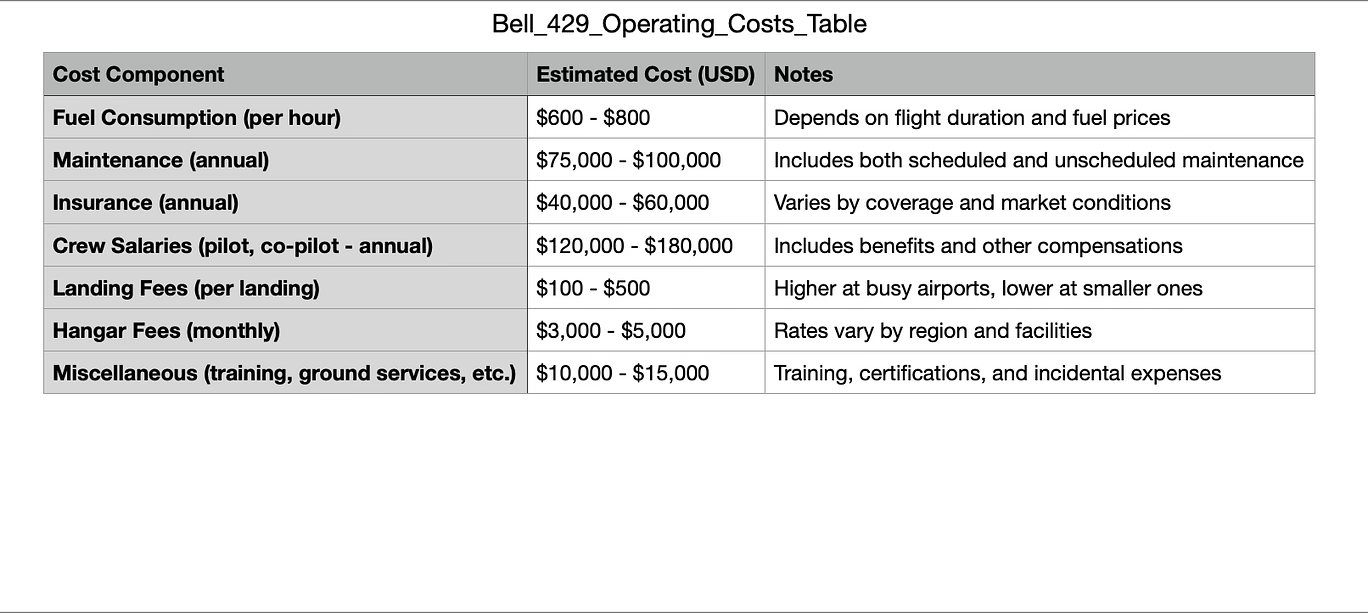
Operating the Bell 429 involves significant costs, which vary based on mission type and usage patterns. Below is a breakdown of key cost components:
Fuel Consumption
Assuming an average of 450 flight hours per year and fuel priced at $7 per gallon, the total fuel cost can be estimated at $315,000 annually. Fuel remains a significant portion of the variable operating costs.
Maintenance Costs
Annual maintenance for the Bell 429 typically ranges from $75,000 to $100,000, depending on flying hours and aircraft condition. Regular scheduled maintenance and unscheduled repairs are necessary to ensure the aircraft remains airworthy.
Insurance
Insurance premiums can range from $40,000 to $60,000 per year, influenced by factors such as the operator’s mission profile and flight history. Corporate operators may have lower premiums, while EMS or law enforcement operators may face higher rates due to increased operational intensity.
Crew Salaries
Annual salaries for a pilot and co-pilot can range from $120,000 to $180,000, depending on experience and certification levels.
Landing Fees and Hangar Fees
Landing fees vary by location but typically range from $100 to $500 per landing. Hangar fees can cost between $3,000 and $5,000 per month, depending on the region and facility quality.
Bell 429’s Key Competitors
Despite its many strengths, the Bell 429 faces competition in the light twin-engine market. Below are some of its main rivals:
Airbus H145 (formerly EC145)
The Airbus H145 is a versatile multi-mission helicopter with a larger cabin than the Bell 429. It is frequently used for EMS, law enforcement, and corporate transport. Known for its performance in hot-and-high environments, the H145 excels in missions that demand both power and cabin space.
Leonardo AW109
The Leonardo AW109 is favored for its speed and luxury, often used in high-end corporate transport. With a faster cruise speed and sleek design, the AW109 is a top contender for VIP transport and law enforcement.
Leonardo AW169
The AW169 offers a larger cabin and greater payload than the Bell 429, making it suitable for EMS, search and rescue (SAR), and offshore operations. It offers advanced avionics and a strong balance of power and cabin space.
Sikorsky S-76D
The Sikorsky S-76D is known for its premium cabin and long range, making it a favorite in corporate transport and offshore oil and gas missions. It is more luxurious than the Bell 429 and offers greater range, appealing to high-end customers.
MD Helicopters MD 902 Explorer
The MD 902 Explorer features the NOTAR (No Tail Rotor) system, which reduces noise and enhances safety. This helicopter is a strong competitor in urban law enforcement and EMS sectors, thanks to its compact size and quiet operation.
Final Thoughts: Cost vs. Value
The Bell 429 remains a highly versatile and high-performing helicopter that is suitable for a variety of missions, from EMS and law enforcement to corporate transport. Its advanced avionics, safety features, and multi-mission capabilities make it a strong option for operators seeking a flexible aircraft.
However, buyers must carefully weigh the operating costs—fuel, maintenance, insurance, and crew salaries—against the benefits. While the Bell 429 is a cost-effective option for many operators, those flying fewer hours or requiring more specialized configurations may find other helicopters, such as the Leonardo AW109 or Airbus H145, to be better suited to their needs.
Ultimately, the Bell 429’s blend of performance, safety, and flexibility ensures that it remains a competitive and valuable option in the light utility helicopter market.