

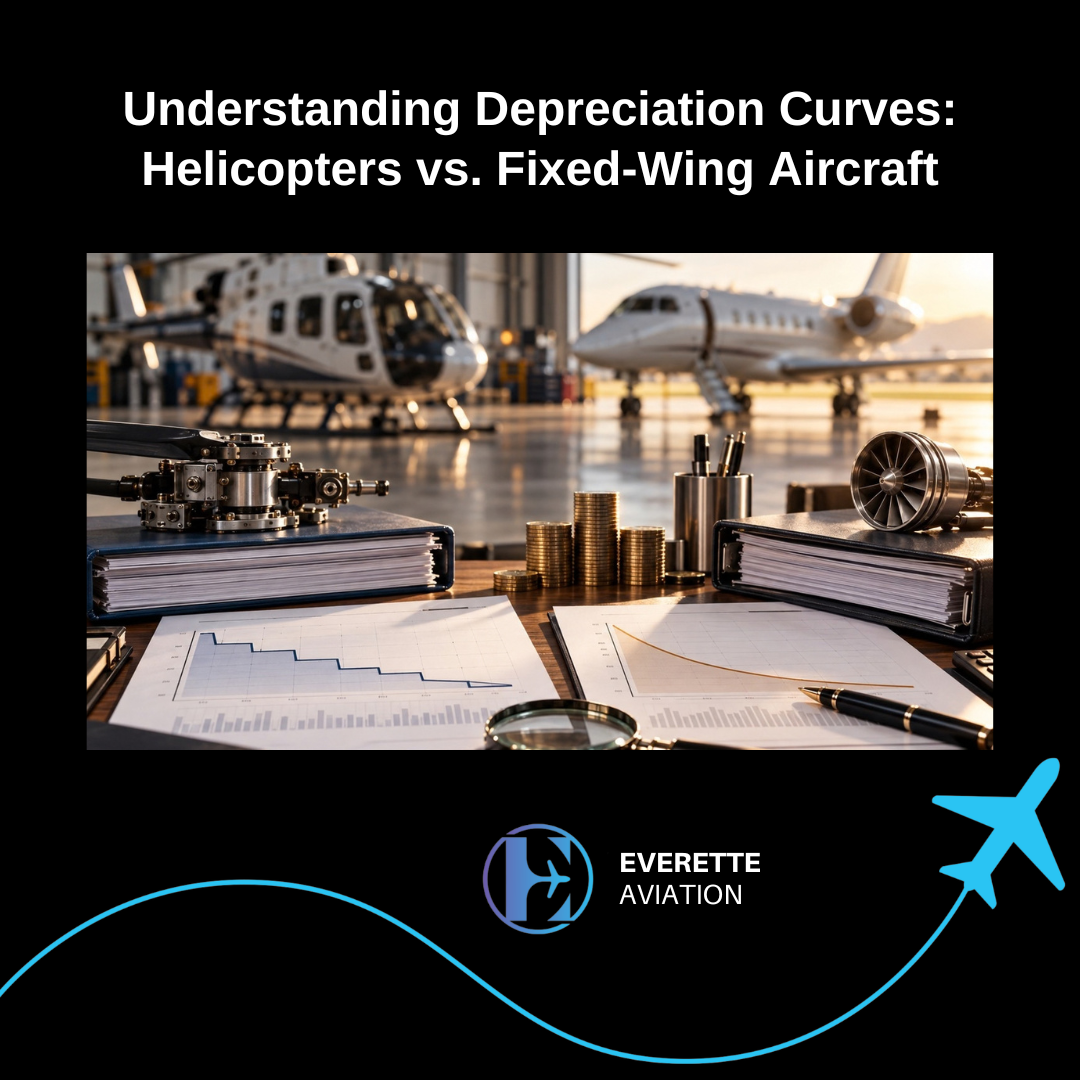
When clients ask why their helicopter didn’t depreciate the way their old business jet did, the honest answer is that rotorcraft and fixed-wing aircraft follow fundamentally different value curves. Understanding why requires looking past the balance-sheet definition of depreciation and into how each aircraft type is actually built, operated, and maintained.
Two Different Starting Points
Accounting depreciation — the straight-line or MACRS schedule a CPA uses for tax purposes — has almost nothing to do with market depreciation, which is what an appraiser measures. Market depreciation reflects how much a willing buyer will actually pay for the aircraft at a given point in its life, and that curve is shaped by the aircraft’s engineering, its maintenance structure, and the market it serves.
Fixed-wing aircraft, particularly turboprops and business jets, tend to follow a smoother, more predictable depreciation curve. Helicopters follow a curve with more steps, more plateaus, and more sensitivity to specific maintenance events. To understand why, you have to look at how each airframe is built and maintained.
Why Fixed-Wing Depreciation Is Comparatively Smooth
Business jets and turboprops are largely governed by hourly and calendar-based inspection programs, engine TBO (or on-condition monitoring for many turbofans), and airframe life limits that are often expressed in tens of thousands of hours. A mid-life jet with a well-documented maintenance history and enrollment in an hourly cost maintenance program (JSSI, PowerAdvantage, TAP Blue, etc.) tends to depreciate in a fairly linear fashion, because:
- Airframe life limits are rarely a near-term concern
- Engine programs smooth out the cost of overhauls, so buyers aren’t pricing in a looming expense
- Avionics and interior condition, not airframe hours, often drive value differences within the same model year
- The used market is deep enough that comparable sales data is relatively continuous across the age spectrum
The result is a curve that looks close to a gentle downward slope, occasionally interrupted by market-wide events (fuel price shocks, new model introductions, economic downturns) rather than by anything specific to the individual airframe.
Why Helicopter Depreciation Moves in Steps
Helicopters are mechanically a different animal. Dynamic components — main rotor blades, main and tail rotor gearboxes, hydraulic servos, and in many designs the entire main rotor head — carry hard time limits rather than on-condition monitoring. When a component reaches its life limit, it must be replaced or overhauled regardless of its physical condition. This creates a value curve with two distinct effects that fixed-wing buyers rarely have to think about:
1. The “time-remaining” effect. A helicopter’s value at any given moment is heavily influenced by how much life is left on its most expensive dynamic components before the next overhaul or replacement. Two otherwise identical airframes with the same total time can have meaningfully different fair market values if one has 200 hours left on its main gearbox and the other has 1,800.
2. The reset effect. When major dynamic components are overhauled or replaced, the aircraft’s value can step back up, sometimes significantly, even though total airframe time hasn’t changed. This is unlike fixed-wing depreciation, where an engine overhaul smooths out cost but rarely produces a visible “step” in market value, because on-condition engines aren’t approaching a hard replacement deadline in the same way.
The practical result is a helicopter depreciation curve that looks more like a descending staircase than a slope — trending downward over time, but with visible upward corrections around major component events.
Mission Profile Adds Another Layer
Helicopter values are also more sensitive to mission-specific wear than most fixed-wing aircraft. An EMS or SAR helicopter operated in a high-cycle, hoist-heavy mission profile accumulates fatigue-relevant stress differently than the same airframe used for VIP transport, even at identical total time. Offshore oil & gas helicopters operating in salt-air environments face corrosion exposure that inland corporate aircraft rarely see. Fixed-wing aircraft experience mission variation too, but the effect on value is generally smaller, because most business aircraft missions (charter, corporate transport, personal use) impose relatively similar wear patterns.
This is one reason appraisers weight logbook and maintenance record review so heavily for helicopters. Total time and cycles alone don’t tell the full story; the appraiser needs to understand what the aircraft was doing during that time.
Age and Obsolescence Behave Differently Too
In fixed-wing markets, avionics obsolescence has become one of the largest drivers of accelerated depreciation. An aircraft without ADS-B Out, modern WAAS/LPV capability, or a supported avionics suite can lose value quickly relative to peers, independent of airframe condition. Helicopters are affected by the same trend, but the effect is often muted by mission requirements — many helicopter missions (utility, agricultural, some EMS operations) don’t require the same avionics sophistication as IFR business aviation, so the market penalty for older avionics is less severe than it is for a jet competing in the charter or Part 135 IFR market.
What This Means for Owners and Buyers
For an owner, understanding these curves matters most at two moments: when deciding whether to complete a major overhaul before selling, and when timing a sale relative to upcoming component life limits. Selling shortly before a major dynamic component reaches its life limit typically nets a lower price than selling shortly after a fresh overhaul, even though the calendar difference might be small.
For a buyer or lender, it means that “total time since new” is a much less reliable single metric for helicopters than it is for fixed-wing aircraft. A thorough valuation has to account for time remaining on life-limited components, the specific maintenance program the aircraft is enrolled in, and the mission history reflected in the logbooks — not just total airframe hours.
The Bottom Line
Fixed-wing depreciation is largely a function of age, total time, and market conditions, producing a relatively smooth curve. Helicopter depreciation is a function of those same factors plus the hard time limits on dynamic components, producing a stepped curve with predictable corrections around major maintenance events. An appraisal that doesn’t account for this difference — treating a helicopter like a jet with rotors — will consistently misstate value at exactly the moments when accuracy matters most: pre-purchase, financing, and litigation.
This article is provided for general informational purposes and does not constitute a formal appraisal opinion. For a USPAP-compliant valuation of a specific aircraft, contact Everette Aviation LLC.